Begonia roseopunctata
A spectacular species begonia admired for its richly coloured foliage and vivid pink spotting, Begonia roseopunctata is a true collector’s plant. Its dark green to bronze leaves are scattered with bright rosy pink spots, often accompanied by fine hairs and richly coloured undersides that give the plant an almost surreal appearance. Native to tropical rainforest habitats, this begonia thrives in warm, humid conditions and makes a stunning addition to terrariums, indoor cabinets, and rare foliage collections.
Compact yet dramatic, Begonia roseopunctata develops increasingly textured and colourful foliage as it matures, especially when grown in stable humidity with soft filtered light.
Scientific Name
Begonia roseopunctata (rose spotted begonia)
Common Name
Rose Spotted Begonia
Origin
Native to tropical rainforest regions of Southeast Asia, where it grows beneath dense forest canopies in warm, humid, shaded environments.
Light
Prefers bright, indirect light. Avoid direct sunlight, especially during the middle of the day, as this can scorch the foliage and fade the pink spotting. Softer filtered light helps maintain the richest colouring.
Water
Keep the soil lightly moist but never waterlogged. Allow the very top layer of soil to begin drying slightly between waterings. Reduce watering during cooler months when growth slows naturally.
Humidity
Thrives in moderate to high humidity levels above 60%. Excellent for terrariums, cabinets, bathrooms, or rooms with a humidifier. Avoid dry air and cold draughts.
Soil
Use a loose, airy, free draining mix rich in organic matter. A blend containing sphagnum moss, fine bark, coco coir, and perlite works especially well.
Food
Feed every 2 to 4 waters during spring and summer using a diluted balanced houseplant fertiliser. Reduce feeding during autumn and winter.
Temp
Prefers temperatures between 18–26°C. Avoid temperatures below 15°C and protect from sudden fluctuations in temperature.
Pet-safe
Toxic if ingested, so keep away from pets and children.
Sprouts Top Tips
Stable humidity and good airflow help prevent crispy leaf edges and encourage stronger colouration. Avoid letting water sit on the foliage for prolonged periods.
Extras
The bright pink spotting can become increasingly vibrant in stable warm conditions with consistent humidity and bright filtered light.
Did You Know?
The species name roseopunctata roughly translates to “rose spotted,” referencing the plant’s vivid pink markings scattered across the foliage.
Product Information
Product Information
Shipping & Returns
Shipping & Returns


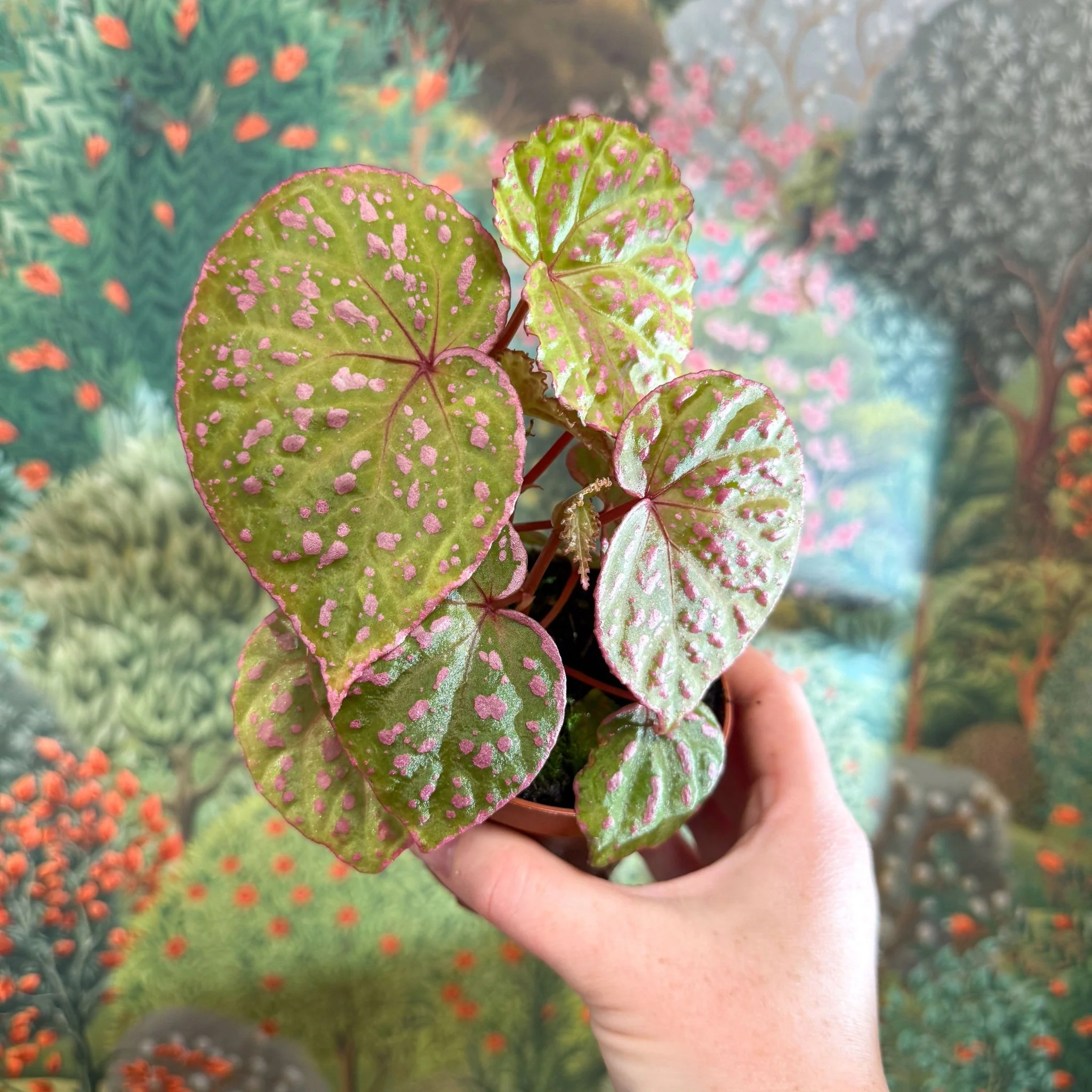


Begonia roseopunctata
Begonia roseopunctata
A spectacular species begonia admired for its richly coloured foliage and vivid pink spotting, Begonia roseopunctata is a true collector’s plant. Its dark green to bronze leaves are scattered with bright rosy pink spots, often accompanied by fine hairs and richly coloured undersides that give the plant an almost surreal appearance. Native to tropical rainforest habitats, this begonia thrives in warm, humid conditions and makes a stunning addition to terrariums, indoor cabinets, and rare foliage collections.
Compact yet dramatic, Begonia roseopunctata develops increasingly textured and colourful foliage as it matures, especially when grown in stable humidity with soft filtered light.
Scientific Name
Begonia roseopunctata (rose spotted begonia)
Common Name
Rose Spotted Begonia
Origin
Native to tropical rainforest regions of Southeast Asia, where it grows beneath dense forest canopies in warm, humid, shaded environments.
Light
Prefers bright, indirect light. Avoid direct sunlight, especially during the middle of the day, as this can scorch the foliage and fade the pink spotting. Softer filtered light helps maintain the richest colouring.
Water
Keep the soil lightly moist but never waterlogged. Allow the very top layer of soil to begin drying slightly between waterings. Reduce watering during cooler months when growth slows naturally.
Humidity
Thrives in moderate to high humidity levels above 60%. Excellent for terrariums, cabinets, bathrooms, or rooms with a humidifier. Avoid dry air and cold draughts.
Soil
Use a loose, airy, free draining mix rich in organic matter. A blend containing sphagnum moss, fine bark, coco coir, and perlite works especially well.
Food
Feed every 2 to 4 waters during spring and summer using a diluted balanced houseplant fertiliser. Reduce feeding during autumn and winter.
Temp
Prefers temperatures between 18–26°C. Avoid temperatures below 15°C and protect from sudden fluctuations in temperature.
Pet-safe
Toxic if ingested, so keep away from pets and children.
Sprouts Top Tips
Stable humidity and good airflow help prevent crispy leaf edges and encourage stronger colouration. Avoid letting water sit on the foliage for prolonged periods.
Extras
The bright pink spotting can become increasingly vibrant in stable warm conditions with consistent humidity and bright filtered light.
Did You Know?
The species name roseopunctata roughly translates to “rose spotted,” referencing the plant’s vivid pink markings scattered across the foliage.
Product Information
Product Information
Shipping & Returns
Shipping & Returns
Description
A spectacular species begonia admired for its richly coloured foliage and vivid pink spotting, Begonia roseopunctata is a true collector’s plant. Its dark green to bronze leaves are scattered with bright rosy pink spots, often accompanied by fine hairs and richly coloured undersides that give the plant an almost surreal appearance. Native to tropical rainforest habitats, this begonia thrives in warm, humid conditions and makes a stunning addition to terrariums, indoor cabinets, and rare foliage collections.
Compact yet dramatic, Begonia roseopunctata develops increasingly textured and colourful foliage as it matures, especially when grown in stable humidity with soft filtered light.
Scientific Name
Begonia roseopunctata (rose spotted begonia)
Common Name
Rose Spotted Begonia
Origin
Native to tropical rainforest regions of Southeast Asia, where it grows beneath dense forest canopies in warm, humid, shaded environments.
Light
Prefers bright, indirect light. Avoid direct sunlight, especially during the middle of the day, as this can scorch the foliage and fade the pink spotting. Softer filtered light helps maintain the richest colouring.
Water
Keep the soil lightly moist but never waterlogged. Allow the very top layer of soil to begin drying slightly between waterings. Reduce watering during cooler months when growth slows naturally.
Humidity
Thrives in moderate to high humidity levels above 60%. Excellent for terrariums, cabinets, bathrooms, or rooms with a humidifier. Avoid dry air and cold draughts.
Soil
Use a loose, airy, free draining mix rich in organic matter. A blend containing sphagnum moss, fine bark, coco coir, and perlite works especially well.
Food
Feed every 2 to 4 waters during spring and summer using a diluted balanced houseplant fertiliser. Reduce feeding during autumn and winter.
Temp
Prefers temperatures between 18–26°C. Avoid temperatures below 15°C and protect from sudden fluctuations in temperature.
Pet-safe
Toxic if ingested, so keep away from pets and children.
Sprouts Top Tips
Stable humidity and good airflow help prevent crispy leaf edges and encourage stronger colouration. Avoid letting water sit on the foliage for prolonged periods.
Extras
The bright pink spotting can become increasingly vibrant in stable warm conditions with consistent humidity and bright filtered light.
Did You Know?
The species name roseopunctata roughly translates to “rose spotted,” referencing the plant’s vivid pink markings scattered across the foliage.


